
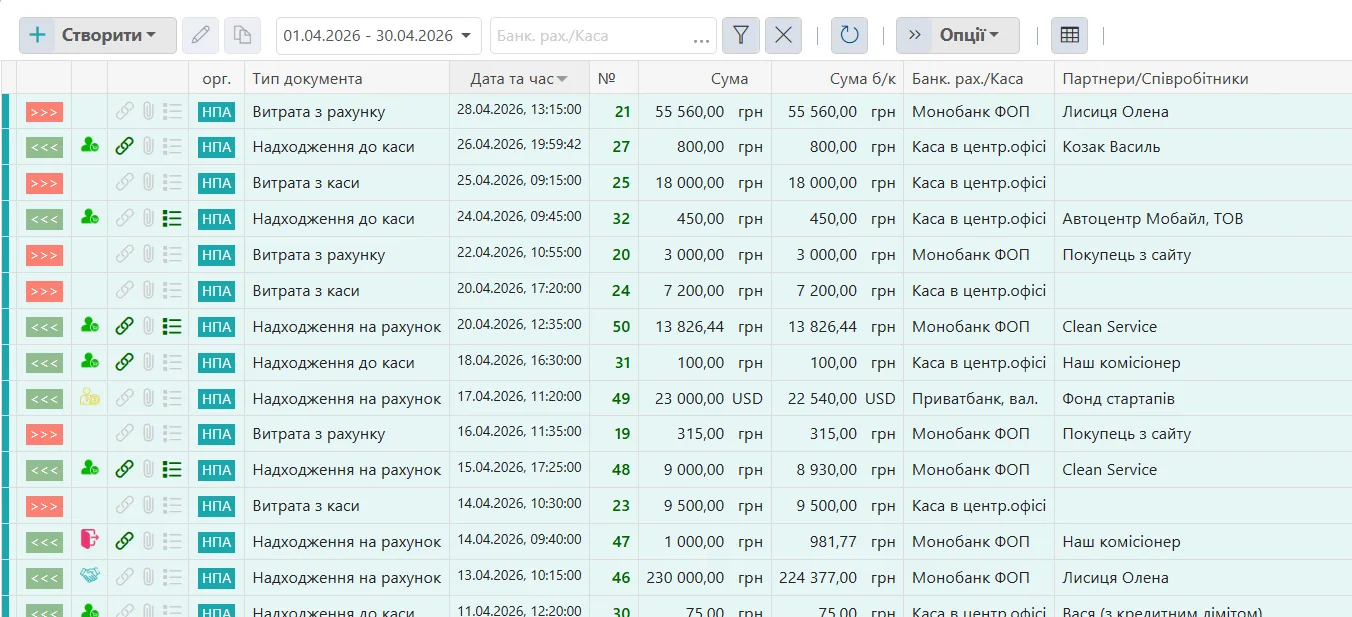
When you work on your own, income and expense tracking usually looks like this: something in your head, something in a notes app, something in the banking app. While turnover is small it even works. Then comes the moment when you have to answer a simple question - how much did I earn this month - and it turns out there is no answer.
Below is the minimum routine that one person can genuinely sustain. No accounting jargon, and no attempt to turn you into an accountant.
First, separate two different jobs
This is the main confusion that makes a sole trader give up on bookkeeping in week two.
- Tax reporting - what you or your accountant file with the state under fixed rules. In Ukraine this is what the FOP regime (the sole-trader status used by most small businesses) revolves around.
- Management accounting - what you personally need: what came in, what went out, what is left and who still owes you.
This article is about the second one. It does not replace your filings, but it is the thing that answers “am I actually earning anything”.
Step 1. Write down where your money physically sits
For a sole trader that is usually two or three places: the business account, cash, and possibly a separate card for one line of work. Until those places are named, any bookkeeping stays approximate.
In QUINCEFIN you do this once: you create a cash desk and a bank account, and from then on every transaction knows where the money came from or went to. The balance then calculates itself, rather than being “I think there was about five thousand in there”.
Step 2. Agree with yourself on categories
An expense without a category is just a minus on the account. A category turns it into information: “rent”, “materials”, “taxes”, “bank fees”, “subscriptions”.
In the system these categories are called cash flow items. A practical tip: do not create forty of them. Seven to ten items that genuinely describe your money give you a readable report, whereas a huge reference list is something you will simply stop filling in.
Step 3. Do not type bank statements in by hand
The most common reason bookkeeping dies is drudgery. So anything that does not have to be typed should not be typed.
In QUINCEFIN a bank statement can be uploaded as a file or pulled in over an API - currently for PrivatBank and Monobank, two of the largest Ukrainian banks. The date, payment number and time, amount, payment reference and counterparty details are filled in from the statement. All you do is check the category and post the document.
Cash still has to be entered by hand, but that is quick: money into the till and money out of the till are two documents with a handful of fields.
Step 4. Issue invoices, even when the customer “will pay anyway”
An invoice is not bureaucracy - it is a way of not keeping debts in your head. Once the invoice is in the system you can see its payment status: paid, partly paid, unpaid or overpaid. In the document journal that is an ordinary filter, so half a minute tells you exactly who owes you money.
For a one-person business this often has more effect than any analytics: money is usually lost not in the numbers, but in forgotten arrangements.
Step 5. Look at two reports once a month
Not ten. Two.
- Cash Flow - the actual movement of money for the period: where it came from and what it went on, broken down by cash desks, accounts and your own items.
- P&L - the financial result: revenue, cost of sales, expenses and net profit.
These are different things, and mixing them up is the most common mistake. There can be money in the account because a customer paid in advance, and no profit for the month. And the other way round: a profitable month with an empty card, because the money went into stock. If the topic interests you, we have a separate look at accrual versus cash accounting.
Four mistakes almost everyone repeats
- Treating money received as your earnings - cost of sales, taxes and expenses still have to come off it.
- Leaving the expense category blank: the report then has one large column called “something”.
- Running several businesses in one file: the numbers blend and no single line of work is visible on its own.
- Recording everything once a quarter. Bookkeeping done “later” is never done at all.
How much time this takes
If the statement comes in automatically and you have about ten categories, the real cost is a few minutes a day and half an hour at month end. That is the volume one person can keep up for longer than a single month.
If you would rather not build this in a spreadsheet
Everything above can be assembled in Excel - and for the first few months that is exactly what people do. But as soon as customer invoices, goods or a second entity appear, the spreadsheet starts eating more time than it saves.
That is the scenario we built QUINCEFIN SOLO for - a simple plan for someone working alone: money, customer invoices, services and goods in one place, from €24 per month and 30 days free without a card. What SOLO includes and when people move up to BUSINESS is on the pricing page.