
“How much do I earn” sounds like a simple question, yet most people who work on their own answer it by guesswork. Usually it comes out as “well, about this much landed on my card”. That is not profit. That is revenue with nothing subtracted from it yet.
Here is how to do the honest version, and what you need to know for it.
Three different numbers everyone mixes up
- Money received - how much physically arrived during the period. Prepayments, repaid debts and even your own transfer between your own cards all land here.
- Revenue - how much you sold in goods or services during the period, regardless of when you were paid.
- Profit - what is left after cost of sales and expenses. That is your actual earnings.
Which is why “good month, 80 thousand on the account” means nothing until you know how much of that money has already gone on stock, rent and materials.
The formula fits on one line
Revenue − cost of sales = gross profit. Then: gross profit − expenses = net profit.
All the difficulty sits in the second word.
What cost of sales means if you are not a factory
Cost of sales is what you spent directly on the specific item sold or the specific job done.
- Retail: the purchase price of the exact unit you sold. Not the shop average, and not “I think I paid about that”.
- Services with materials (a nail technician, a photographer who prints, a repair shop): the materials consumed on that job.
- Pure services (consulting, design, tutoring): there is barely any cost of sales - here profit is shaped by expenses, not by purchases.
Cost of sales is exactly where the real result tends to hide: a high-markup item may sell rarely, while the “cheap” one quietly brings in most of the money.
The expenses people forget
When you work alone, expenses look small and therefore go uncounted. Add them up once for a month - they often come to 15–30% of what you thought you had earned:
- taxes and social contributions;
- bank and payment-service fees;
- rent for a space, a chair or an office;
- software subscriptions and phone;
- advertising and promotion;
- delivery and packaging.
What this looks like in a system rather than in your head
QUINCEFIN answers this with two reports, and they answer different questions.
The P&L report shows the period total: revenue, cost of sales, gross profit, operating expenses and net profit at the bottom. That is the answer to “how much did I earn”.
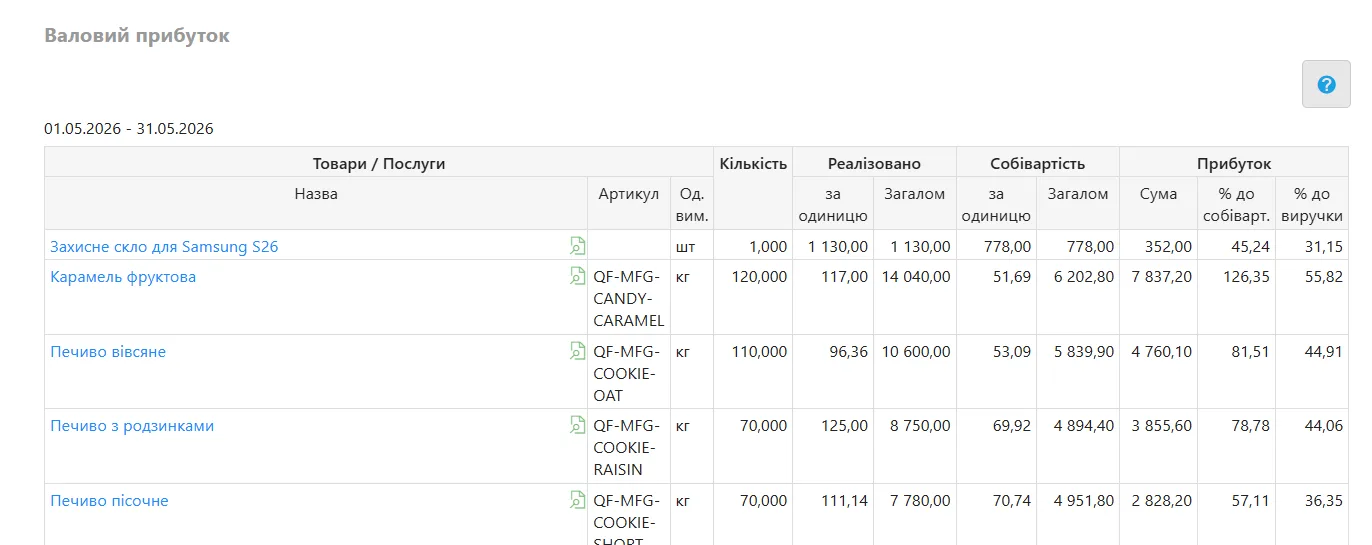
The Gross profit report breaks the same thing down by line: how much of each product or service was sold, what it cost, how much profit it brought and what percentage of revenue that is. That is the answer to “what exactly am I earning on”.
Both reports use data you enter anyway: purchases, sales and payments. Nothing has to be calculated separately.
Why there is profit but no money
This is normal in retail: a profitable month with an empty account, because the money is sitting in stock on the shelf or in unpaid customer invoices. And the other way round - plenty of cash because you took a prepayment for work you still have to do.
So it is worth watching two things at once: P&L to see whether you are earning, and Cash Flow to see whether you can cover the next payments. We looked at the difference between the two approaches in the article on accrual versus cash accounting.
Where to start this week
- List everything that came in last month.
- Subtract the purchases of goods or materials that went into those particular sales.
- Subtract taxes, fees, rent and subscriptions.
- Compare the result with what you assumed about that month.
The first time you can do this in a notebook. The problem starts in month two, when you have to repeat it by hand.
When the system should do the counting
If you work alone and would rather not rebuild a spreadsheet every month, take a look at QUINCEFIN SOLO: you enter purchases, sales and payments, and the system works out revenue, cost of sales and profit itself. From €24 per month, 30 days free, no card required. The full contents of the SOLO and BUSINESS plans are on the pricing page.